

Bury Your Hands in the Soil, Not Your Head in the Sand
Resistance Gardening

What is your garden protesting?
I was not surprised to come across the question while casually scrolling. Lately, it seems all that I do, read, and encounter is aligned with all that I believe, value, and work towards. It was only a few days before I shared a message in a similar vein.
The message was an illustration of a thought pattern—indicating resistance from all that opposes our values can be accomplished by reclaiming community, true self-sufficiency, and hope for a more equitable world.
What does this look like? What can gardening really accomplish? How do we balance these acts while staying informed and vigilant?
With so many questions on my mind I began researching and the algorithms have been rewarding me ever since. Every media platform I log into, whether traditional or social, I am fed thoughtful insights and research on the ripple impacts gardening has on our lives and the communities we call home. It is a concept that finds footing in the Victory Gardens of the First and Second World Wars.
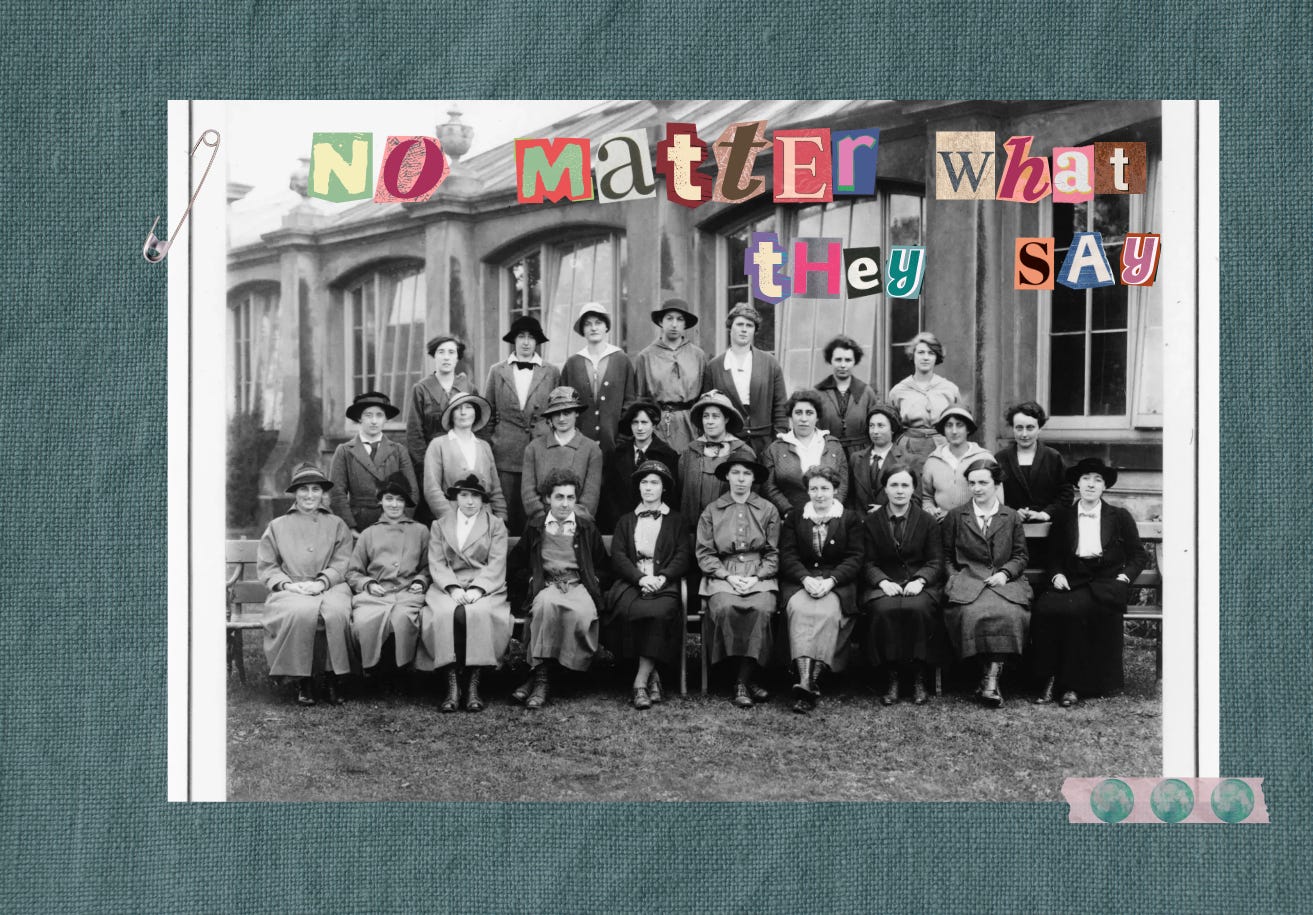
“When the First World War broke out in 1914, Kew employed female horticulturists to replace the men who had left to join the war effort. Over 30 women gardeners worked at Kew until 1918; they were instrumental to maintaining the Gardens during the war. During their time at Kew, the women gardeners also attempted to improve working conditions by petitioning on issues such as hours of work and rates of pay on behalf of both women and men.”
Original Photo Credit: November 1916 © RBG Kew
Victory gardens were a source of fresh vegetable and herbs supplied to citizens and troops during war times. They could be found in backyards, rooftops, city parks, and vacant lots. Governments supplied seeds, guidance, and land to support the international movement. The gardens were filled intentionally, with vegetables high in nutritional content to adequately nourish the greatest number of people. Crops like beans, beets, cabbage, carrots, kale, lettuce, peas, tomatoes, and turnips were popular.
When wartimes halted, the majority abandoned their gardens, with the expectation that the food supply chain would resume production and distribution. I wonder if they had known how fragile the chain is, if they would have made a different decision. If perhaps they would have retained the type of self-sufficiency that exists only in localized communal efforts.
What everyone gets wrong, or at least what I got wrong, about gardening is that is it useful beyond a triage scenario or casual hobby. More relevantly, that it is not a retreat from reality or abdication of social responsibility, at least when done intentionally.
Today gardening, as an act of resistance, expands beyond the need to put food in hungry mouths. Advocating for native plants addresses growing concerns surrounding pollinator habitat and threats of drought. A call to action to purchase local produce comments on the astronomical energy and packaging that feeds our supply line. Reconsidering overconsumption lends itself to awareness of exploitative conditions for agricultural workers. Establishing community gardens, rejects the notion that we are too different to stand side by side. Each thought and action, feeds into another—a highly complex network of behaviors that evolves to enact lasting change.
So in times where we may feel a lack of hope or direction, an impulse to bury our head in the sand—or our thoughts in a media feed—look to gardening. The benefits are more than I have the time to write about. I often hear that people believe they simply can’t keep a plant alive, they have a “black thumb”—people who garden successfully are not inherently magical or special. They were fortunate enough to be guided by the wisdom of others, allowing their inputs to decrease.
To help cut your inputs down, I’ll leave you with this:
The 5 Essential Pillars of Gardening You Need to Know
Site Assessment
Start by evaluating your garden space. I mean it, if you are fortunate enough to start with a blank slate, make the most of it. The countless hours I have spent undoing what someone else (or I) did in haste or ignorance, just to be able to reconsider the space with intention. Once you’ve evaluated, take pencil (not pen) to paper and sketch out the space and create a plan. Where will your walkways be? Is there a seating area? Will you have rows of raised beds? I once heard that all great gardens have a destination. Mine has several.
You will want to map sunlight conditions, learn your region’s soil type, test the soil on your property through your local extension office, understand your drainage and water sources (if you’re unsure on your property’s water sources contact your city utilities office).
Innovative Irrigation
After you’ve completed your site assessment and understand the layout of your current and desired landscape, you can begin to convert or install appropriate irrigation. Water can easily become the greatest fiscal (and ecological) cost of gardening if you are not mindful. Keep a map of all existing and added irrigation handy—you never know when you might need to do repairs, and you won’t want to dig up half your yard to do them.
Efficient watering is key to a healthy garden. Learn about drip irrigation and emitter types, soaker hoses, and rainwater collection (check your local laws) to conserve water and provide consistent moisture to your plants.
Hardscape and Softscape
Hardscapes can increase the temperate around homes retaining heat reaching temperatures of up to 160°F in Texas. You’ve been warned—installing a giant concrete pad off the back of our home could lead to unexpected energy costs, and can do significant damage to ecological function. There are many beautiful alternatives like gravel and stone patios interspersed with groundcovers. You will want to refer to your garden plan to determine which hardscape and softscape materials you will install.
Perhaps controversial, but turf isn’t inherently bad. Grasses can be excellent choices to enhance soil stability in high traffic areas—just make sure you’re selecting native grasses and not invasive—boo bermuda. Balance structural elements (paths, raised beds, trellises) with bio features (plants, ground cover, mulch) to create a functional and visually appealing garden.
Plant Selection
The best part! I am a huge advocate for native plants, they are the lowest long term costs considering maintenance and water needs. Did you know many native plants are edible and provided pollinator habitat, making them multifunctional beauties? That being said, gardening should be fun and multi-functional. Adapted vegetable varieties make a great addition to any space, and ornamental plants the inspire you to take better care of your garden are a net positive when utilized with restraint and added with consideration. If you live in a very cold and wet climate, and are determined to install a cactus garden—you’re going to be disappointed and waste energy in the process.
Choose plants that suit your climate, soil, and gardening goals. Consider native plants, companion planting, and seasonal rotations (or if you’re feeling it—permaculture) for a resilient garden.
Communal Efforts
It takes a village, and it really does. I often say everyone has a green thumb, but not everyone has the time to use it. If you are someone who feels they are not fit for gardening, it could be you just need a little help from your friends. Community gardens are a great way to both build and support communities, and they can take all sorts of shapes—a backyard garden only your family and neighbors have the key to, an existing city wide initiative, an allotment managed by a local nonprofit.
Connect with local gardening groups (both in person and online), join seed swaps, and get comfortable with grant writing for shared knowledge, free resources, and community support to enhance your gardening success.
I absolutely used to think of gardening as just a hobby or something you do when you have ‘extra time.’ But the way you framed it...as something bigger, more intentional, and even a form of social responsibility, completely shifted my perspective. It’s not an escape from reality, it’s a way to engage with it in a more meaningful, hands-on way. I love this so much!
This is wonderful and helpful information- we have moved a lot - but always tried to have a small garden - the last couple years - we haven’t been able too- but this year we hope to put one in. I also have a lil hydroponic one on my counter- I absolutely adore.
Thanks for sharing this! I was just speaking to someone (a spiritual mentor of sorts) and we talked about getting through challenging times- and we were talking about WW2 and how people coped-' and it was just what you wrote about - !!❤️❤️❤️❤️